Lake Tazawa
田沢湖
Lake Tazawa, Semboku, Akita, is Japan's deepest lake at 423 meters, a caldera lake known for its clear blue waters and the golden statue of Tatsuko.
〒 014-0511How to get there
松葉Akita Nairiku Line82 min walk from the station
The first time I stood on the shore at Haruyama before 7:00, the lake wasn't blue at all. It was silver, flat as glass, holding the whole sky upside down. Fifteen minutes later, once the sun cleared the ridgeline, the color shifted into that sapphire people talk about, and I understood why a heartbroken princess supposedly still lives beneath the surface. Lake Tazawa (田沢湖), tucked into Akita Prefecture, is the deepest lake in Japan at 423.4 meters at its darkest point, and it rewards the kind of quiet, early-morning attention most day-trippers skip right past.
Here's what's actually worth knowing before you go: the history that shaped the shoreline, why the water looks the way it does, where to base yourself, and which of the surrounding hot springs are worth the detour.
A Lake Shaped by Deep Time
The recorded history picks up in the Edo period. In 1602, the Satake clan was reassigned from Hitachi Province (modern-day Ibaraki Prefecture) to govern Akita's six counties, and a checkpoint went up at Obonai, marking the border between the Nanbu and Akita domains, a reminder that this quiet lakeside was once a genuine political frontier. Through the 18th century, the domain pushed land reclamation using water drawn from the lake and reformed local forestry practices, and the surrounding region eventually built a reputation as one of Japan's notable horse-breeding areas.
When Japan introduced its modern municipal system in 1889, the villages of Obonai, Tazawa, and Jindai were formally established as separate administrative units. Obonai became a town in 1953, and in September 1956 all three merged into Tazawako Town (田沢湖町), the name the area still carries today.
The hardest chapter in that history came in 1940, when highly acidic water from the Tamagawa River was diverted into the lake for hydropower and agricultural reclamation. The kunimasu, a landlocked salmon species found nowhere else on Earth, was wiped out. For decades the lake was, in that specific sense, dead. Neutralization treatment of the acidic inflow has since brought fish back to the water, one of the quieter environmental recovery stories in the region, and one most guidebooks never mention.
Why the Water Looks Like That
Lake Tazawa is almost perfectly circular, with a 20 km shoreline and a surface area of 25.5 km². What makes it the deepest lake in Japan is the drop-off: 423.4 meters straight down, deep enough that the water holds a density and clarity that reads as sapphire blue rather than the murkier green-brown of most Japanese lakes. It's the kind of color that makes the Princess Tatsuko legend, a young woman who, seeking eternal beauty, was transformed into the dragon deity of the lake, feel less like folklore and more like an obvious conclusion.
The lake changes character by season, and it's worth timing a visit around what you actually want to see:
Spring: soft, diffused light sits on the surface rather than glaring off it.
Summer: deep green forest presses right up against the blue, sky and water nearly matching.
Autumn: the surrounding foliage turns and reflects across the water in a way that photos never quite capture.
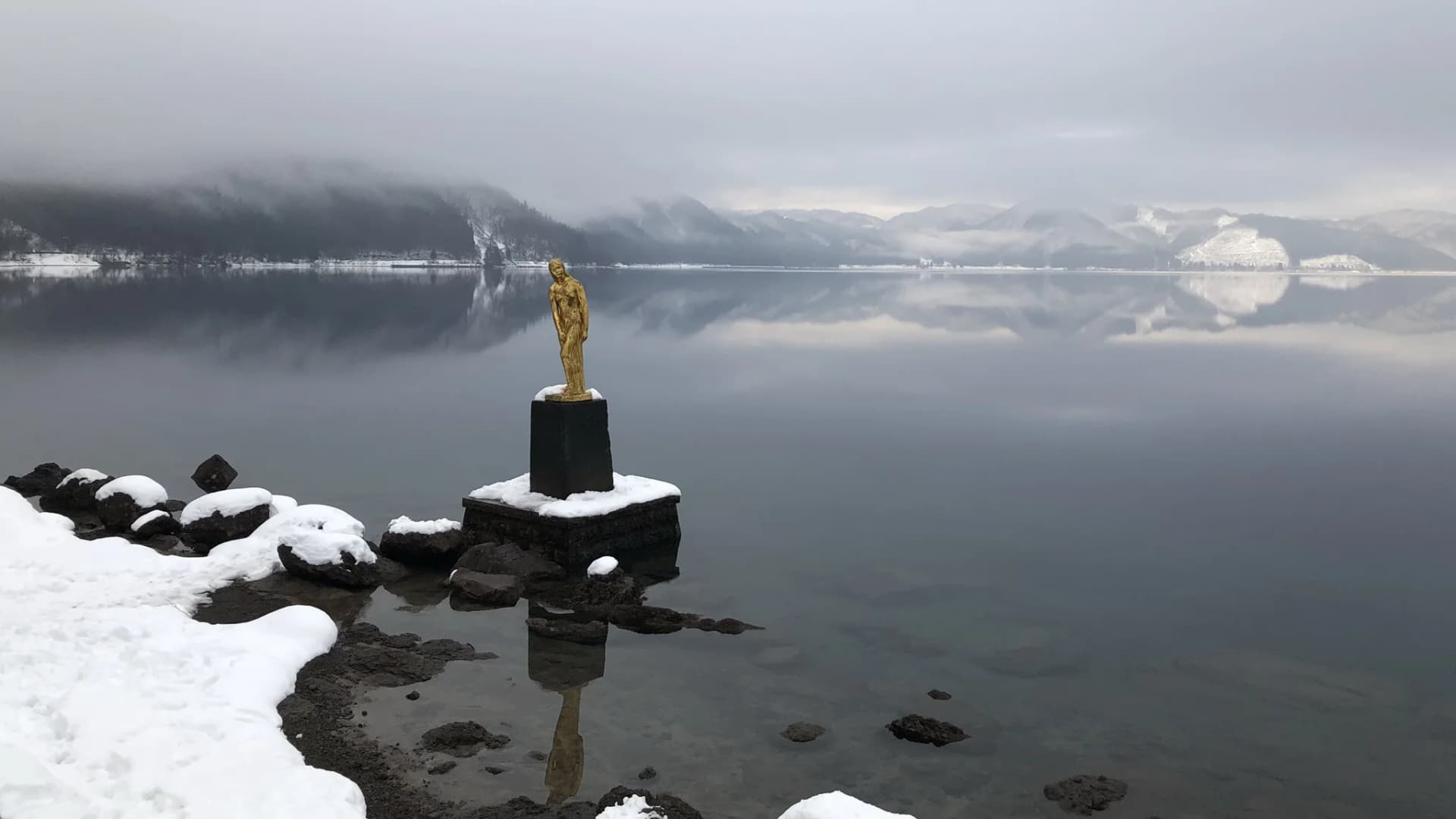
Winter: snow-white shoreline against a lake that rarely fully freezes, given its depth, a stark, high-contrast scene.
On a still morning, before wind picks up off the surrounding ridges, the lake turns mirror-flat and throws the sunrise back at you. That window is short, so go early.
Haruyama: Your Base on the Lake
Haruyama, about 12 minutes by bus from JR Tazawako Station, is the practical center of gravity for a Lake Tazawa visit.
Getting there: JR Tazawako Station, then local bus to Haruyama.
What's there: hotels, ryokan, and rest houses cluster along the shore, and sightseeing boats also depart from here. If you're visiting in autumn, this is also the starting line for the Lake Tazawa Marathon.
What to do:
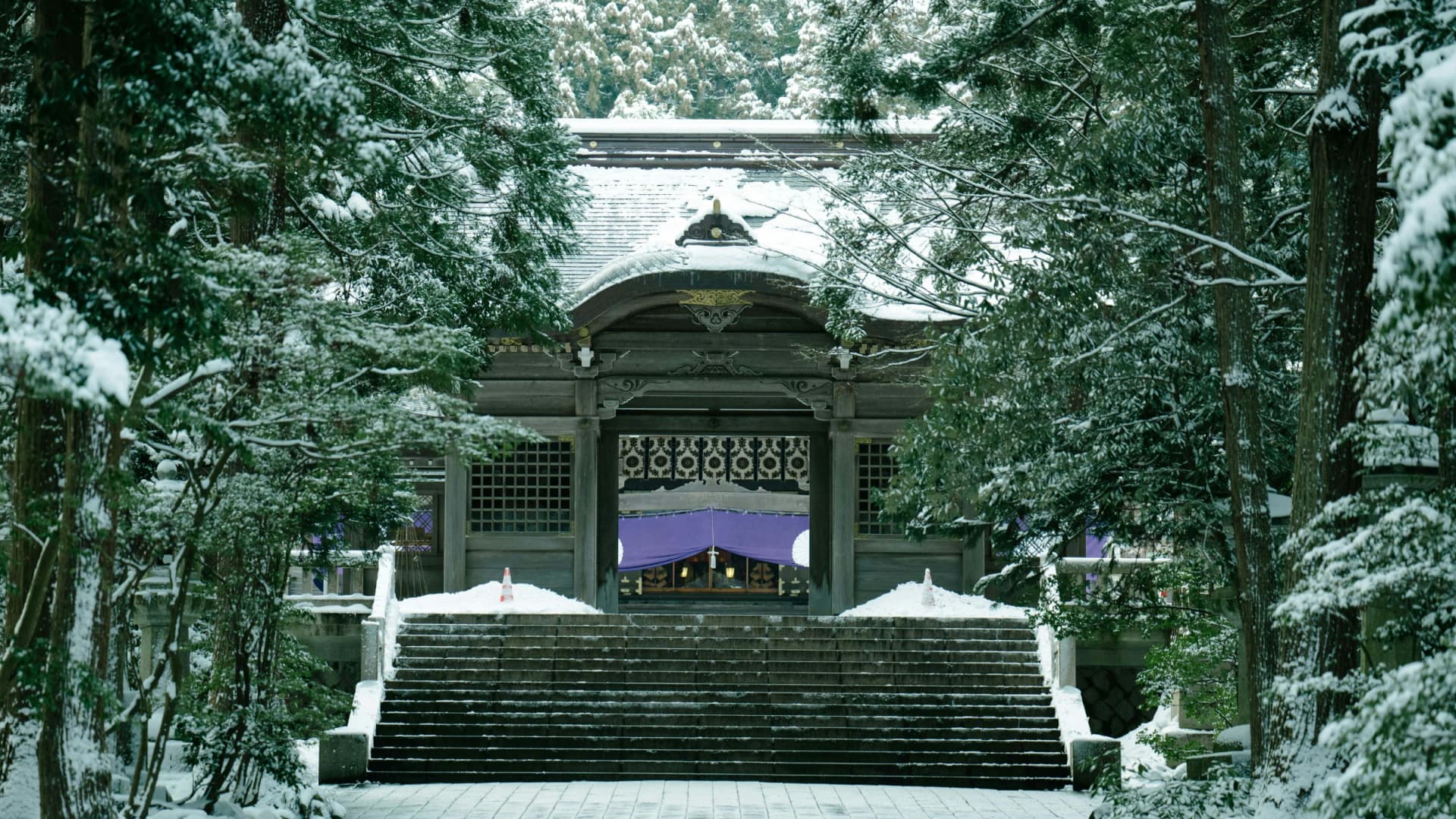
Gozaishi Shrine: dedicated to the lake's deity, and the obvious stop if the Tatsuko legend has any pull on you.
The Statue of Tatsuko: a bronze figure of the legendary princess, sculpted by former Tokyo University of the Arts professor Yasuda Funakoshi, standing at the water's edge.
Kenmin no Mori: a forest planted with tree species drawn from across Japan, good for an unhurried walk between lake activities.
On the water: cycling the lakeside road, kayaking, SUP, and camping are all set up here, and renting a kayak for an hour gives you a completely different read on the water's color than standing on shore does.
The Hot Springs Ringing the Lake
This is the part of a Lake Tazawa trip that turns a day visit into an overnight one. The lake sits inside a cluster of genuinely distinct onsen areas, and they're not interchangeable; each has a different personality.
Nyuto Onsen Village (乳頭温泉郷): Seven secluded hot springs deep in the mountains, the closest thing in the area to the hidden, rustic bathhouse fantasy most people have of rural Japan. This is the one worth the extra travel time.
Tazawako Kogen Onsen: Sits with a view over both the lake and Mount Akita Komagatake, and doubles as a trailhead if you're climbing the mountain.
Misuzawa Onsen: Near Tazawako Ski Resort, with a wider mix of accommodation types: hotels, ryokan, quirky pensions, and guesthouses.
Tamagawa Onsen: Claims the highest natural spring output from a single source in Japan, and draws visitors specifically for its therapeutic mineral waters.
Getting There

Planning a trip? Fit this into a trip and Oni plans the rest around it.
You might also like

Kakunodate Castle Remains
Early seventeenth-century castle ruins where the Ashina clan held their regional stronghold, with surviving stone walls and moats now a public park.
Semboku · Akita
Namahage Sedo Festival
A renowned winter festival recreates the Namahage tradition where demon-like figures visit shrines and homes, recognized as one of Japan's three strangest festivals.
13–15 Feb 2027 · Dates not yet confirmedOga · Akita
Japan Game Awards 2026
Japan Game Awards 2026: "Pokemon Pokopia" takes the Grand Award, "Word Game" the Game Designers Award, and the Pokemon series a ministry honour for 30 years.
2026/09/15
Shinzan Shrine
This shrine atop Mount Shinzan in Akita honors mountain deities and houses a thousand-year-old kaya tree among ancient cedar groves.
Oga · Akita
Akita Kanto
A summer harvest festival features towering bamboo poles adorned with paper lanterns, paraded through streets with traditional music and daytime balancing performances.
3–6 Aug 2027 · Dates not yet confirmedAkita
Akita Museum of Art
Akita Museum of Art displays Japanese and international contemporary art, traditional works, and sculptures, with an outdoor sculpture park and rotating special exhibitions.
Akita