

Udo Jingu
鵜戸神宮
A shrine on the coast of Miyazaki whose vermilion hall stands inside a sea cave, with a rock said to have nursed the god born there.
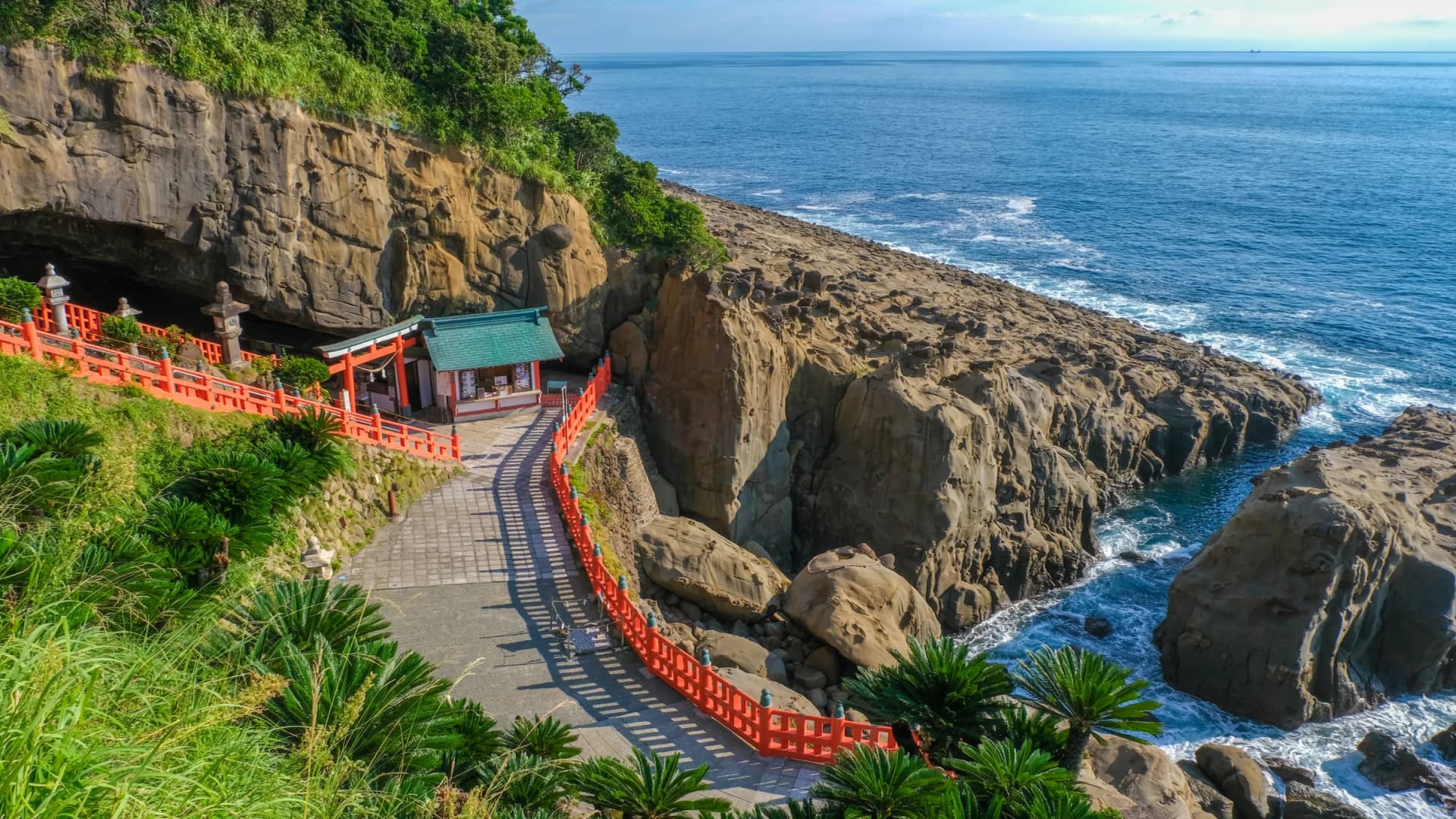
Udo Shrine stands on the coast at Nichinan, on a headland above the Hyuga Sea. Its main hall is built inside a cave in the cliff, on the spot where the god of the shrine, Ugayafukiaezu, is said to have been born.
The shrine is said to date from the reign of Emperor Sujin. In 782 a monk named Kokibo Kaikyu was appointed by imperial order to take charge of it. He rebuilt the hall and founded a temple beside it, and for centuries afterwards the two stood together: the temple held six images of Kannon, and the place was known as the Koya of the west, after the great temple complex at Koyasan.
The temple was dissolved at the Meiji Restoration, when Buddhist and Shinto institutions were separated by law, and what remained became the shrine of today.
The hall is painted vermilion and stands under the roof of the cave. Five further gods are enshrined with the main one. The building has been repaired many times since the eighth century, most recently in 1968 and 1997, and is a Cultural Property of the prefecture.
At the back of the cave is the rock called Ochichi-iwa, the breast rock. Toyotama-hime, the mother of Ugayafukiaezu, is said to have left her breasts fixed to the cave wall so that her child could be fed after she departed. Water still drips from it, and it is a place of prayer for safe birth and for the raising of children. A sweet is made from the water and sold at the shrine.
Below the hall, out on the rocks, lies the Kameishi, a stone about eight metres long said to be the turtle Toyotama-hime rode to come ashore. There is a square hollow in its back. Visitors throw clay balls at it, men with the left hand and women with the right, and a ball that lands in the hollow is said to carry the wish with it.
The shore itself is layered sandstone and mudstone, tilted and worn into ridges by the sea. Rock of this kind along the Miyazaki coast is known as the devil's washboard.
You might also like

Morioka Fall Festival
One of Iwate's most enduring celebrations, this autumn festival originated as prayers for harvest, now featuring ornate floats and traditional parades.
14–16 Sep 2026Morioka · Iwate
Kanamara Matsuri "Festival of the Steel Phallus"
An annual Shinto festival at Kanayama Shrine in Kawasaki featuring distinctive phallic imagery in decorations and parades while raising funds for HIV research.
5 Apr 2027Kawasaki · Kanagawa
Kuji Autumn Festival
This over 650-year-old festival in a northern mountain town expresses gratitude for the harvest while praying for protection from disaster and the arrival of good fortune.
17–20 Sep 2026Kuji · Iwate
Uto Shrine
Guardian shrine of Aomori dedicated to the Three Goddesses of Munakata, featuring grounds with a sacred spring and historic remains including haiku stones by Matsuo Basho.
Aomori
Jozankei Shrine
A Shinto shrine in Sapporo's Jozankei hot spring resort area, dedicated to the god of hot springs and healing, surrounded by nature and autumn foliage.
Sapporo · Hokkaido
Kumano Taisha Shrine
One of three major Kumano shrines in Japan, Kumano Taisha was established in 806 and is known as the Ise Shrine of the North for its significance.
Nanyo · Yamagata