Nishiyama Koryuji
西山興隆寺
A mountain temple in Saijo, Ehime, founded in 642, reached by a long approach under maples, with a main hall that is an Important Cultural Property.
〒 791-0505
壬生川Yosan Line98 min walk from the station
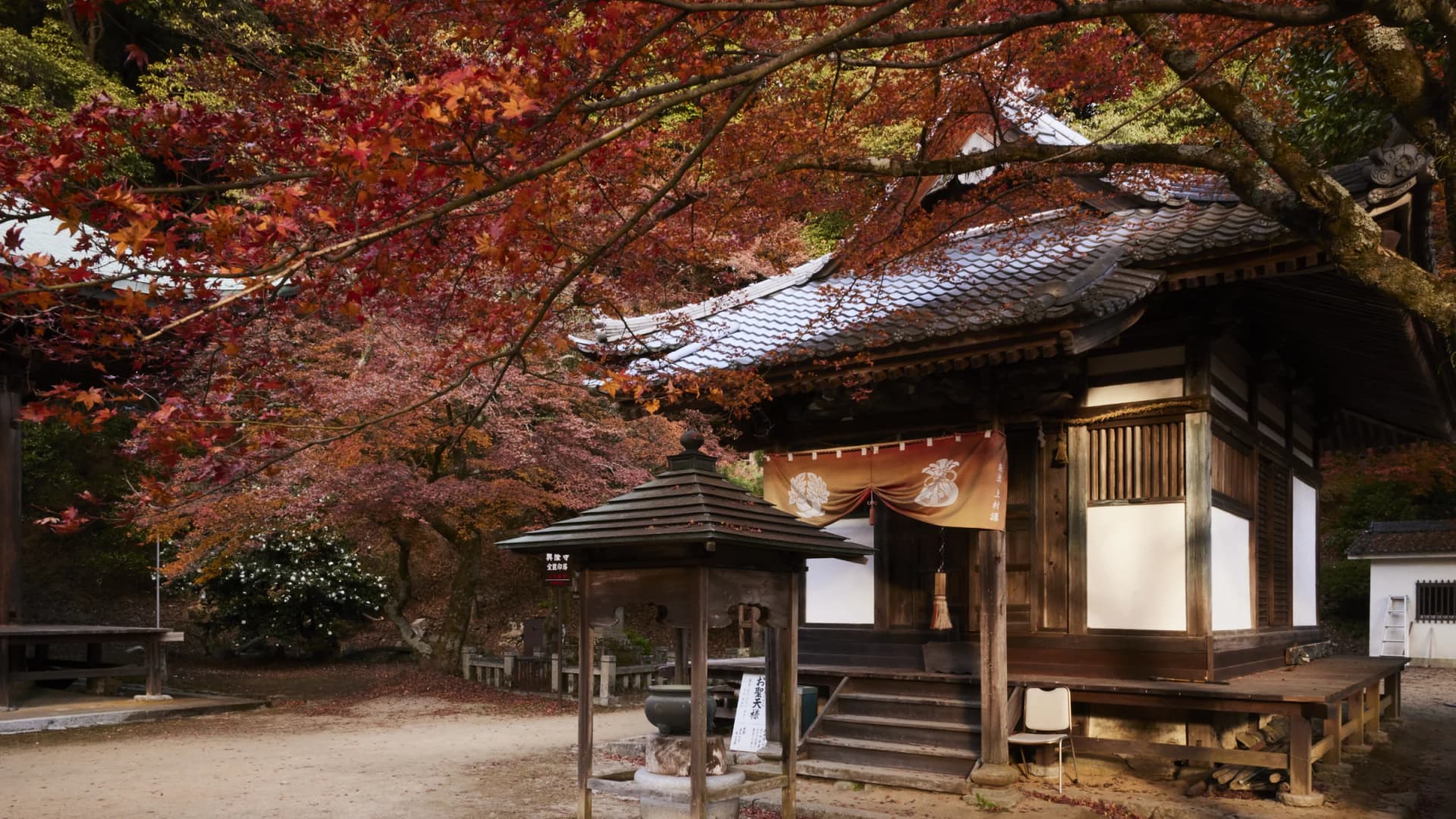
Koryuji stands on a wooded hillside at Tanbara in Saijo. It belongs to the Daigo branch of the Shingon school, and its main image is the thousand-armed Kannon. It is the tenth of the twenty temples that make up the second Shikoku pilgrimage, the one kept alongside the eighty-eight.
The temple dates its founding to 642, in the reign of the empress Kogyoku, by a monk called Kuhatsu Shonin.
Three later figures are recorded as having come to the mountain: Gyoki, who travelled the country building temples and public works in the eighth century; Hoon Daishi; and Kobo Daishi. The temple was supported by the imperial house, by warriors and by the lords of the domain, as well as by people living around it.
The way up to the temple is a long approach under maples, and the hillside is a place of scenic beauty designated by the prefecture.
Other things lie along it: a stream called the Miyurugi, a waterfall named after Fudo Myoo, a fierce guardian of the Buddhist teaching, a viewpoint, a three-storey pagoda, and a circuit of eighty-eight small stations that repeats the whole Shikoku pilgrimage within the grounds.
The main hall is an Important Cultural Property, along with a bronze bell, a stone reliquary pagoda and two ridge tags recording construction.
The prefecture lists a standing bronze figure of a buddha and the temple's documents, as well as the hillside noted above. The town lists the three-storey pagoda, another stone pagoda, a Chinese fir and a camellia called the Kumagai.
You might also like

Kongobu-ji (Koyasan)
Mount Koya is a sacred temple complex where the entire mountain is treated as one unified holy domain dedicated to Shingon Esoteric Buddhism.
Koya · Wakayama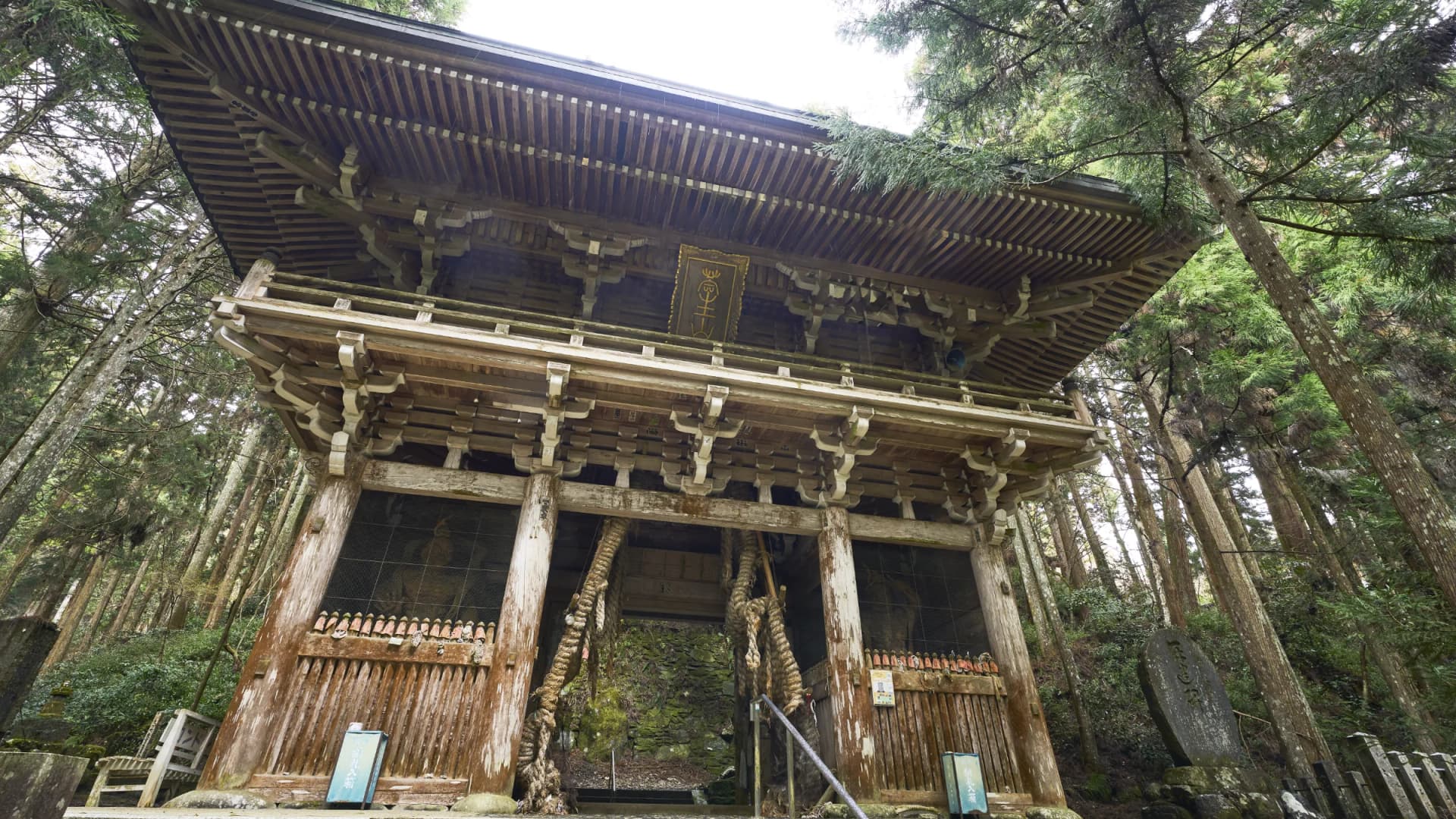
Daihoji Temple
The forty-fourth temple of the Shikoku pilgrimage and its halfway point, standing among old trees at 579 metres in the mountains of Ehime.
Kumakogen · Ehime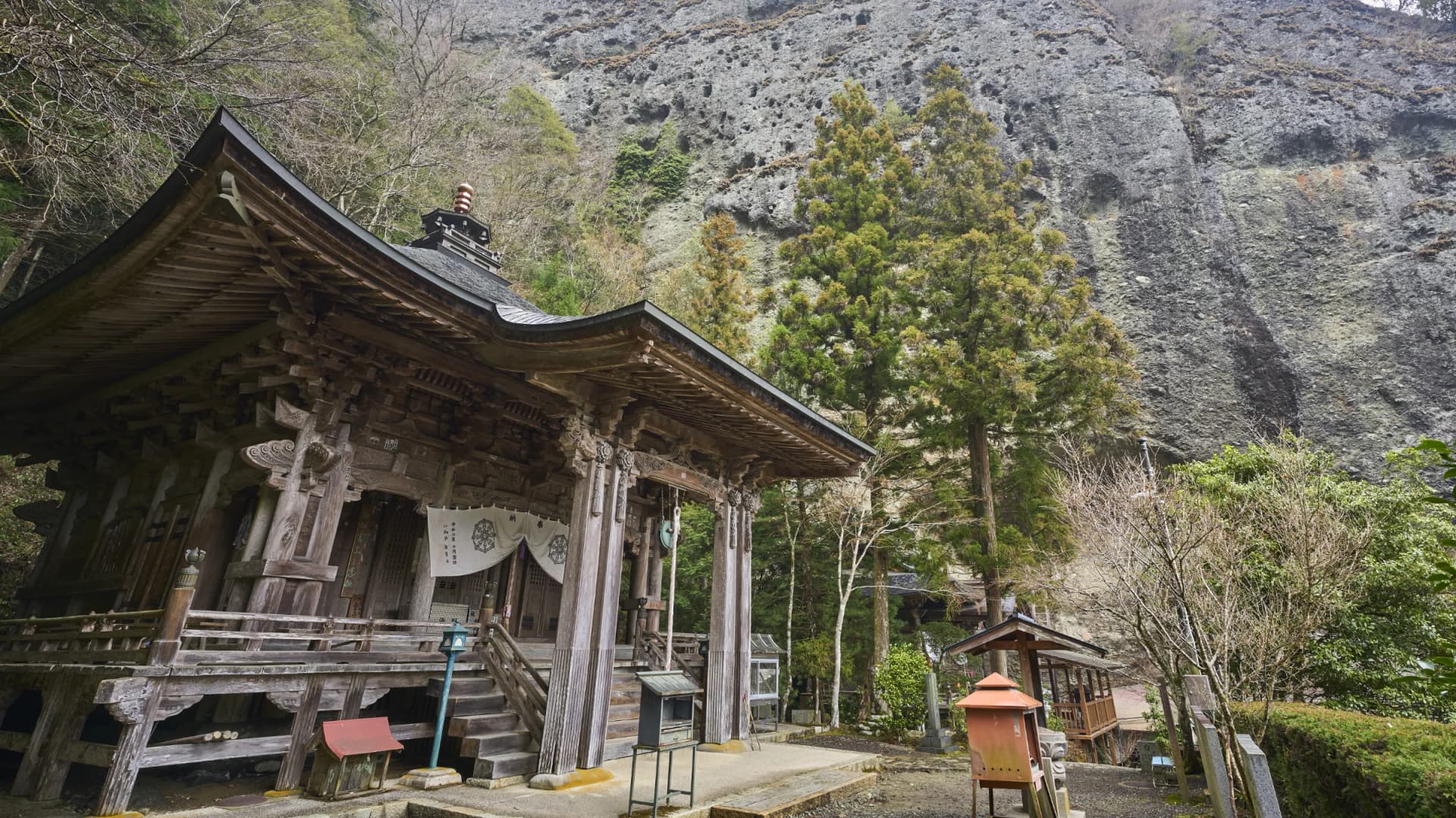
Iwayaji Temple
The forty-fifth temple of the Shikoku pilgrimage, built against cliffs in the mountains of Ehime, where the mountain itself is the object of worship.
Kumakogen · Ehime
Special Exhibition: Kobo Daishi Kukai — Treasures of Koyasan and the Spread of the Faith
An exhibition at the Kyushu National Museum on Kukai, who brought esoteric Buddhism from Tang China, with treasures of Koyasan and of western Japan.
24 Apr – 20 Jun 2027Dazaifu · Fukuoka
Hyakusaiji Temple and the Buddhist Art of Omi
An autumn exhibition in Shiga where the hidden image of Hyakusaiji, an eleven-headed Kannon of the 8th century, leaves the temple for the first time.
26 Sep – 6 Dec 2026Koka · Shiga
Rikugien Garden Night Autumn Viewing
Rikugien Garden opens for nighttime autumn foliage viewing, illuminating the garden's fall colours alongside projection mapping and carefully framed photographic vistas.
28 Nov – 9 Dec 2026Tokyo