

Shiromineji Temple
白峯寺
Temple 81 of the Shikoku pilgrimage, on Mt Shiromine in Kagawa, where the exiled Emperor Sutoku was laid to rest after his death in 1164.

Treasure hall 9:00-15:00, by reservation at least 10 days ahead.
〒 762-0016How to get there
鴨川Yosan Line58 min walk from the station
Shiromineji is a Shingon temple of the Omuro school, about 280 metres up Mt Shiromine in the Goshikidai hills, where the cities of Sakaide and Takamatsu meet in Kagawa Prefecture. It is temple 81 on the Shikoku pilgrimage. The principal image is a Senju Kannon, the thousand-armed form of the bodhisattva of compassion, to whom people pray for protection from misfortune.
The temple is tied to Emperor Sutoku, who died in exile in this province and was cremated on the mountain. It is known for its cherry blossom, hydrangeas and autumn leaves.
History
The temple counts two founders. Kukai, the founder of the Shingon school, is said to have come to the mountain in 815 and buried a nyoi hoju, a wish-granting jewel, on its peak. In 860 the monk Enchin saw a glowing piece of driftwood in the Seto Inland Sea. According to the temple's account, he followed its light to the mountain, met its white-haired guardian deity there, and carved the Senju Kannon from the wood.
The temple once had 21 subtemples. Fire and war destroyed it several times, and it was rebuilt with the support of the Ikoma family and then the Matsudaira, the lords of Takamatsu. The main hall dates from 1599, a rebuilding by Ikoma Chikanori. The present form of the temple goes back to the Meiji period.
Emperor Sutoku
Sutoku, the 75th emperor, lost the Hogen Rebellion of 1156 to Emperor Go-Shirakawa and was sent into exile in Sanuki, the old province that is now Kagawa. He died there in 1164. He was cremated on Chigogadake, beside the temple, and his tomb, the Shiromine Misasagi, stands there today.
Emperors, nobles and warriors made offerings for him in later centuries. Emperor Go-Komatsu granted the name Tonshoji. The poet-monk Saigyo came in 1166 and is said to have exchanged poems with the emperor's spirit at the tomb. Two thirteen-storey stone pagodas, from 1278 and 1324, are traditionally held to have been raised by Minamoto no Yoritomo for the emperor's repose. A memorial rite, the Goshoshinsai, is held at the tomb every year.
Some classical texts describe Sutoku as a vengeful spirit. The temple points out that the Imakagami chronicle records his grief and illness without any mention of resentment. He came to be regarded as a guardian of Shikoku, and the temple honours him as a god of learning and the arts.
Buildings
Eleven of the halls and gates are Important Cultural Properties. Besides the main hall, they include the Daishi hall dedicated to Kukai, rebuilt in 1811 by the Takamatsu lord Matsudaira Yorinori, the Amida hall of 1661, the guest hall, and the Shichimune-mon, the main gate, named for its seven roof ridges.
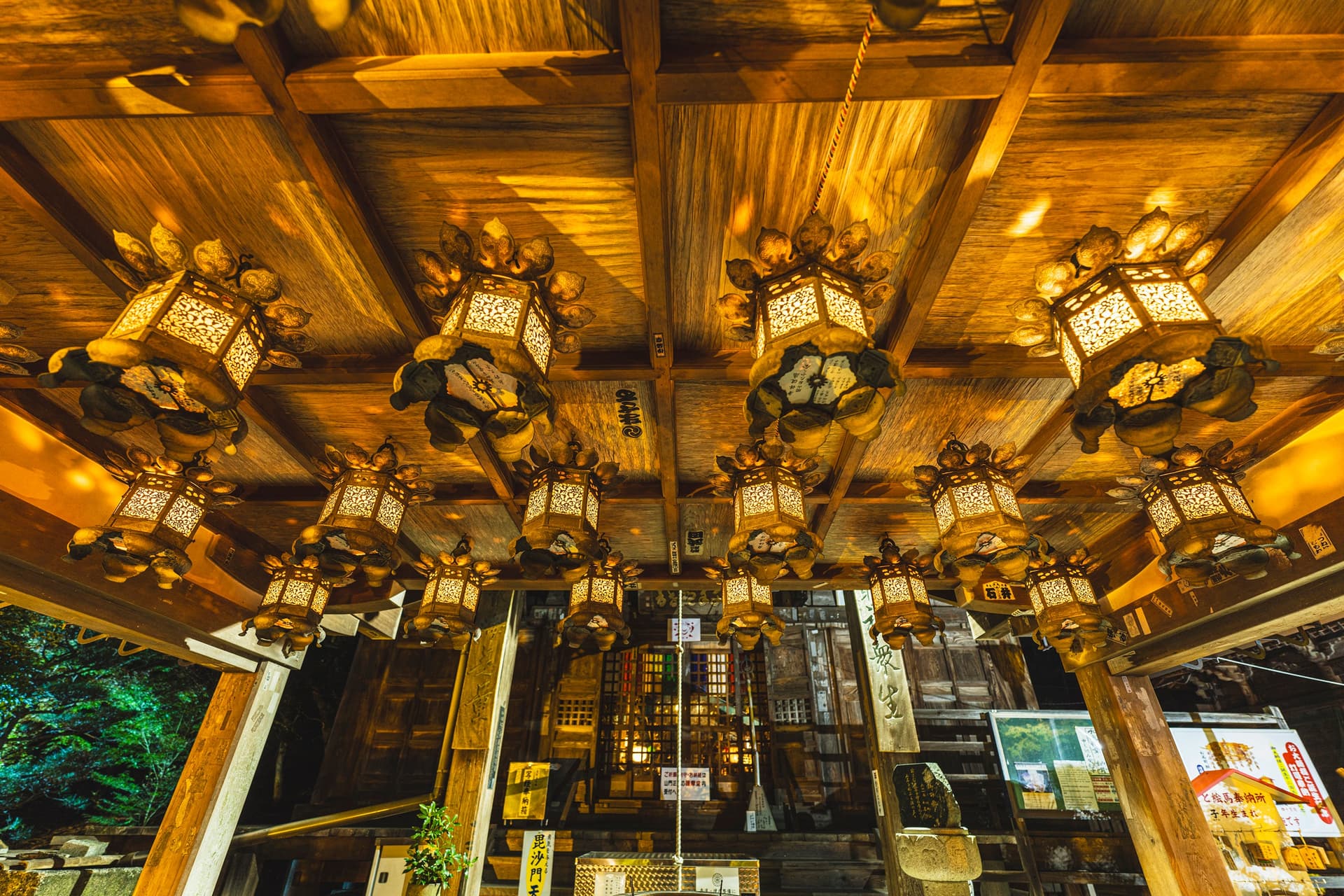
The Tonshoji-den of 1680 is the emperor's memorial hall. It enshrines Sutoku together with Shiromine Daigongen, also called Sagamibo, the temple's guardian. Sagamibo is counted among the eight great tengu, the mountain spirits of Japanese folklore, and is prayed to for household safety, business and success in sport. The Chokugakumon gate in front of the hall was built in the same year. The temple's imperial plaque, itself an Important Cultural Property, is kept in the treasure hall, opened in 2003.
A fir tree about 35 metres tall in the grounds has been a prefectural protected tree since 1979.
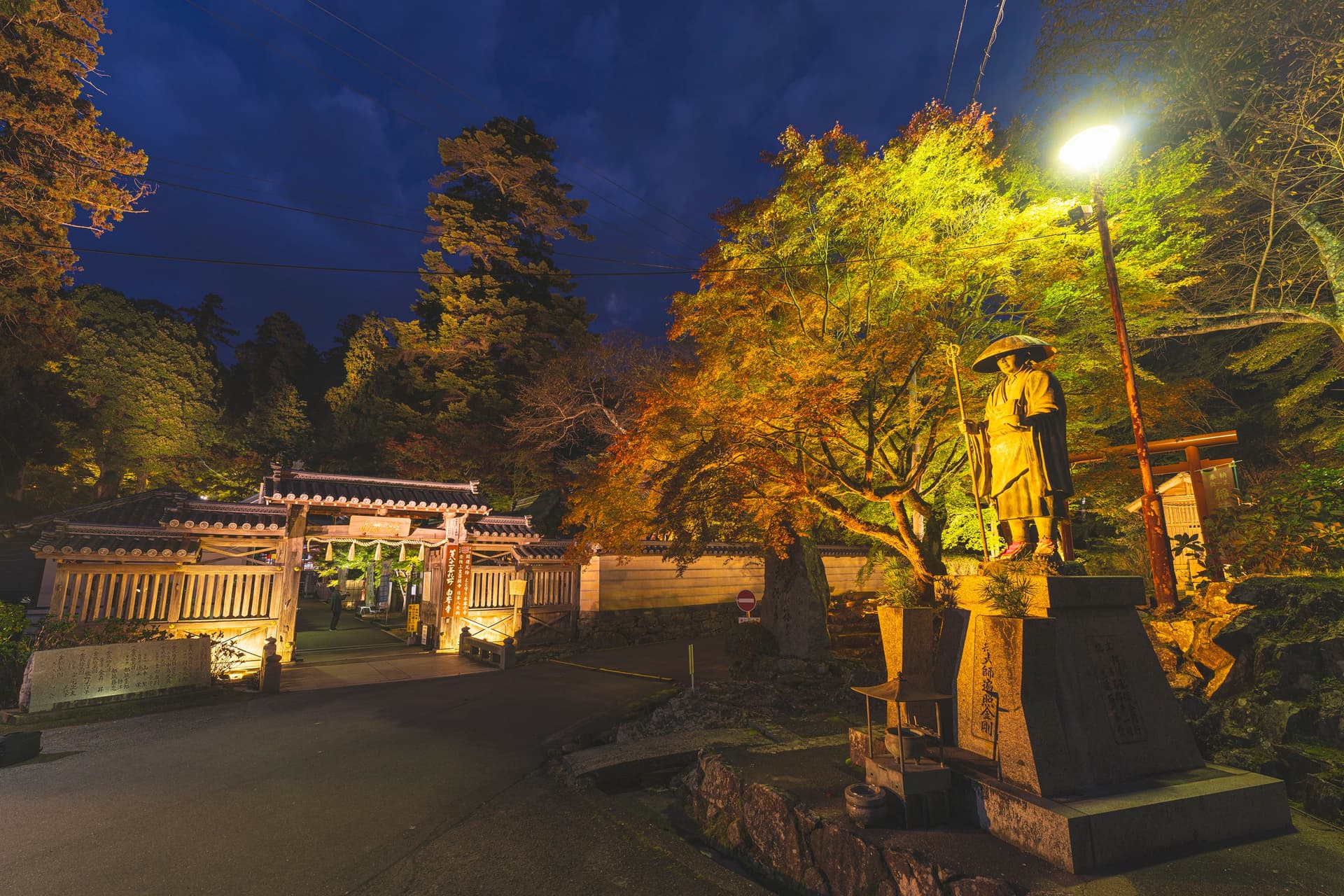
Around the temple
The pilgrim path from Shiromineji to Negoroji, temple 82, was designated a National Historic Site in 2013. The Saigyo path, laid out in 2003, runs for about 1.3 kilometres past 88 stones carved with his poems and 93 stone lanterns. Near the temple are Chigogadaki, a waterfall on a branch of the Oumi river that runs full after heavy rain, and the Okunoin, an inner sanctuary in a cave holding a boat-shaped stone carved with the guardian Bishamonten.
Getting There

You might also like

Kongobu-ji (Koyasan)
Mount Koya is a sacred temple complex where the entire mountain is treated as one unified holy domain dedicated to Shingon Esoteric Buddhism.
Koya · Wakayama
Osu Kannon
A Shingon temple in central Nagoya, moved here by Tokugawa Ieyasu in 1612, whose Osu Bunko library holds a National Treasure manuscript of the Kojiki.
Nagoya · Aichi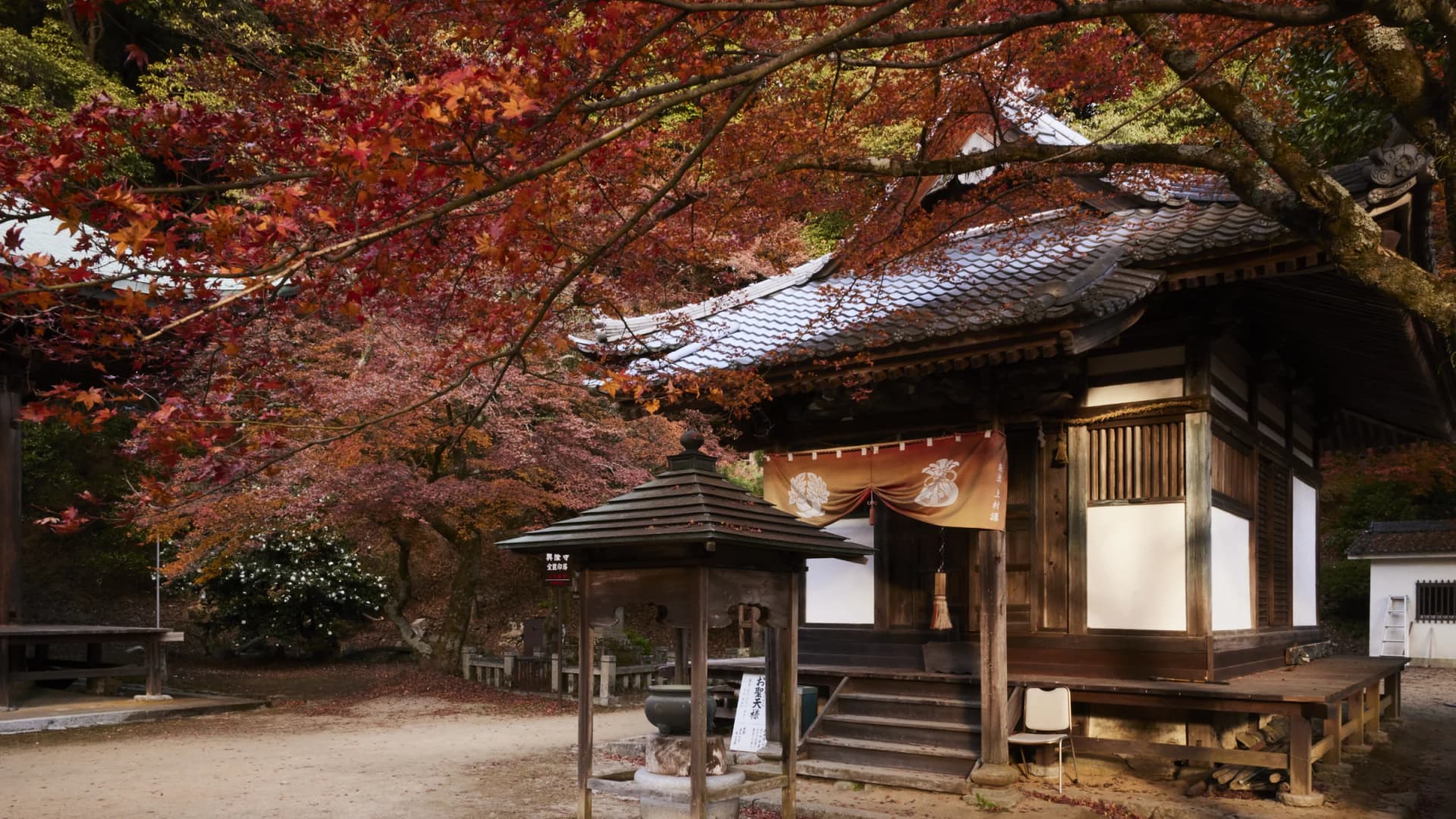
Nishiyama Koryuji
A mountain temple in Saijo, Ehime, founded in 642, reached by a long approach under maples, with a main hall that is an Important Cultural Property.
Saijo · Ehime
Special Exhibition: Kobo Daishi Kukai — Treasures of Koyasan and the Spread of the Faith
An exhibition at the Kyushu National Museum on Kukai, who brought esoteric Buddhism from Tang China, with treasures of Koyasan and of western Japan.
24 Apr – 20 Jun 2027Dazaifu · Fukuoka
Hyakusaiji Temple and the Buddhist Art of Omi
An autumn exhibition in Shiga where the hidden image of Hyakusaiji, an eleven-headed Kannon of the 8th century, leaves the temple for the first time.
26 Sep – 6 Dec 2026Koka · Shiga
ASAKUSA CULTURE & LIGHTS 2026
Five nights of projection mapping on the main hall and gate of Sensoji in Tokyo, with the temple's closed garden and its hall of ema open alongside.
30 Oct – 3 Nov 2026Tokyo


