

Gion Festival
祇園祭
A month-long Kyoto festival centered on Yasaka Jinja Shrine features sacred rituals, food stalls, illuminated floats, and culminates in a grand procession and parade.
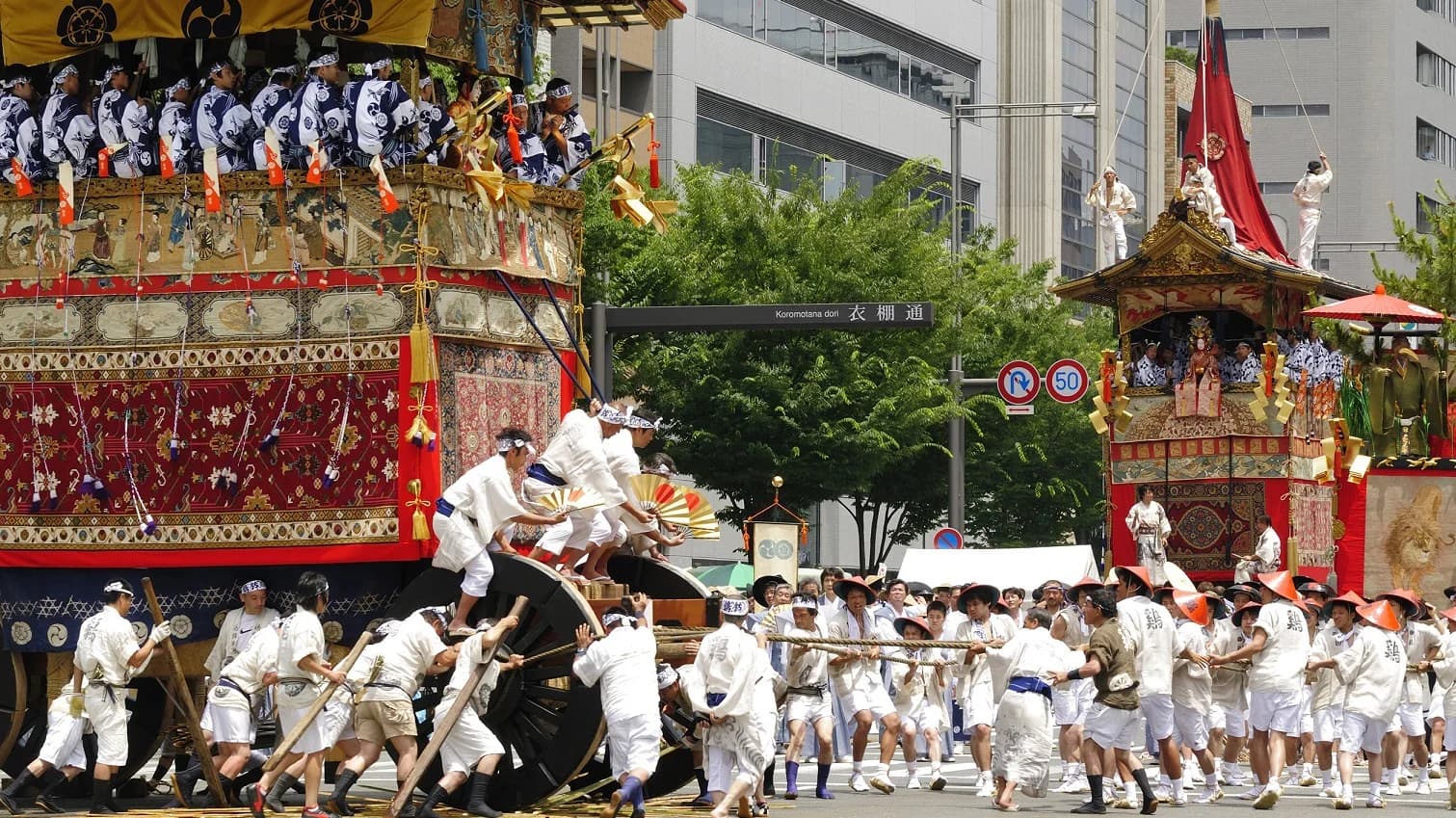
The Gion Matsuri festival stands as one of the most significant annual events associated with Yasaka Jinja Shrine, boasting a rich tradition that spans over 1150 years. This grand celebration unfolds throughout the entire month of July and is steeped in Shinto customs. Its original purpose revolved around purifying and placating disease-causing entities.
The evenings leading up to the main parade, known as Yoiyama (July 14-16 and 21-23), are filled with festivities. The streets are lined with food stalls, and the floats are illuminated and displayed for closer viewing. Traditional music fills the air, and people dressed in yukata (summer kimono) add to the festive atmosphere.
During this month-long festival, a multitude of rituals and events are conducted, creating a jubilant atmosphere in downtown Kyoto, including the Byobu Matsuri, where local residents open their homes to display valuable family heirlooms and folding screens (byobu). Religious ceremonies at Yasaka Shrine and other venues in Kyoto are also integral to the festival, maintaining its spiritual significance.
The festival reaches its pinnacle with the awe-inspiring Mikoshi Togyo procession and the dazzling Yamaboko Junko parade on July 17 and 24.
Designated as an Important Intangible Cultural Heritage by UNESCO, the Gion Festival is not only a vibrant celebration but also a testament to Kyoto’s rich cultural heritage. It attracts visitors from all over the world, offering a unique glimpse into traditional Japanese culture.
Mikoshi Togyo
The Mikoshi Togyo procession occurs during the evenings of July 17 and 24. On July 17, three Mikoshi (portable shrines) carrying the deities of Yasaka Jinja Shrine depart from the shrine, making their way to the Otabisho in downtown Kyoto. There, they pause for a week before returning to Yasaka Jinja Shrine on the night of July 24.
Yamaboko Junkō
Yamaboko Junkō, occurring on July 17 and 24, features processions of ornate festival floats known as Hoko and Yama. A total of 34 of these floats, adorned with lavish decorations, grace the streets of Kyoto in what is often referred to as a moving art museum. Originally, Yamaboko Junkō served to pacify malevolent deities believed to bring about epidemics and misfortunes. During the parade, musicians aboard these festival floats perform traditional Japanese music using instruments like bells, drums, and flutes to dispel lingering spirits. Before the Mikoshi Togyo, the portable shrine procession, Hoko and Yama play a vital role in purifying the city streets. Yamaboko Junkō holds the prestigious status of being registered as a UNESCO World Intangible Cultural Heritage.
Somin Shōrai Protective Charms
These are protective charms crafted from bamboo leaves, exclusively distributed during the Gion Festival in July to ward off epidemics and calamities. These charms bear the inscription "蘇民将来子孫也" (Somin Shōrai's descendants) on the front and are hung from eaves. The origin of these charms lies in the tale of Somin Shōrai, as documented in an excerpt from the "Bingo Province Fudoki". In this story, Susanoo-no-Mikoto, journeying across the southern seas, seeks lodging and encounters two brothers, Somin Shōrai and Kotan Shōrai. Somin Shōrai, the elder brother, lives in poverty, while Kotan Shōrai, the younger one, enjoys prosperity. However, despite his wealth, Kotan Shōrai declines to offer lodging to Susanoo-no-Mikoto, whereas Somin Shōrai, though lacking material wealth, warmly welcomes him with a seat of millet and millet gruel, providing a place to stay. Impressed by the genuine kindness of Somin Shōrai, Susanoo-no-Mikoto makes a promise that in the future, if an epidemic were to spread across the world, those who are descendants of Somin Shōrai will be spared. During the "Yoiyama" period of the festival, each neighbourhood hosting the floats (Yamaboko) offers "chimaki", a type of rice cake wrapped in bamboo leaves, believed to bring specific blessings.
You might also like

Jidai Festival
Kyoto's signature historical reenactment features costumed processions of figures from different Japanese eras traveling from the Imperial Palace to the Heian Shrine.
22 Oct 2026Kyoto
Aoi Festival
The Aoi Festival is one of Kyoto's three major annual festivals, dedicated to the northern Kamo shrines, with roots reaching back over 1,400 years and featuring equestrian archery.
15 May 2027Kyoto
Aizen Festival
A 1,400-year-old temple festival honors a Buddhist deity associated with love and good fortune through public celebrations and sacred displays.
30 Jun – 2 Jul 2027Osaka
Mankusen Shrine
Mankusen Shrine in Izumo is said to be the last stop for the gods of Japan before they return home.
Izumo · Shimane
Kumano Taisha
Kumano Taisha, Izumo's "birthplace of fire", holds sacred hikiriusu and hikirigine fire-drills, a startling rice-cake ritual, and Susanoo's comb festival for Princess Inada.
Matsue · Shimane
Shimogamo Shrine
Dating to the 6th century, this Kyoto shrine dedicated to Tamayori-hime and her father was worshipped as protection against misfortune and a guardian of the capital.
Kyoto