

Kumano Taisha
熊野大社
Kumano Taisha, Izumo's "birthplace of fire", holds sacred hikiriusu and hikirigine fire-drills, a startling rice-cake ritual, and Susanoo's comb festival for Princess Inada.
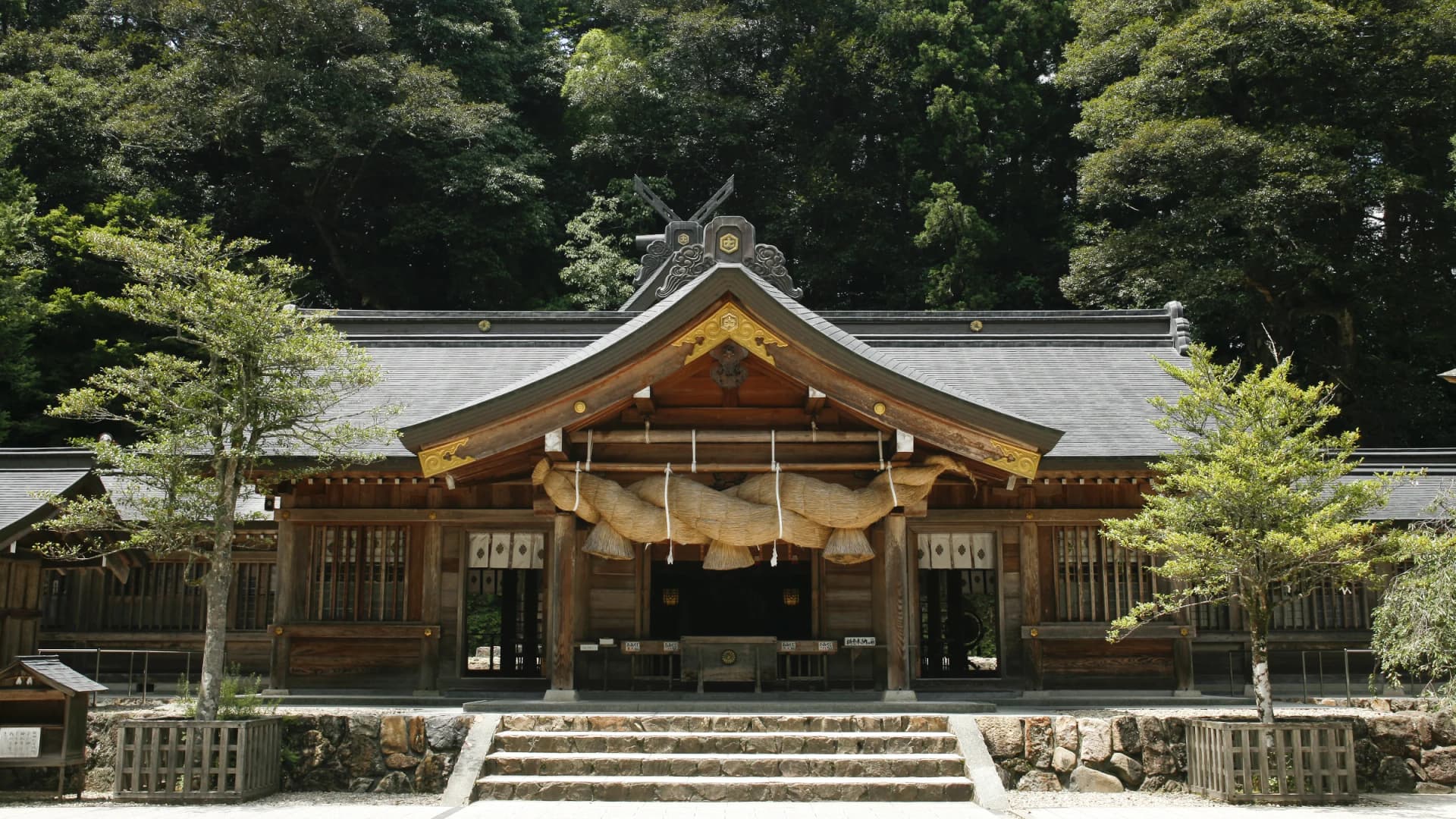
Kumano Taisha is one of the oldest and most venerable shrines in the old province of Izumo. For centuries it ranked as the province's ichinomiya – its highest shrine – held in the same esteem as the great Izumo Taisha, with which it shares a deep and unusual bond. The shrine is dedicated to Susanoo no Mikoto, the storm god of Japanese myth, famous for slaying the eight-headed serpent Yamata no Orochi, here worshipped under the lofty name Kaburogi Kumano Okami Kushimikenu no Mikoto. The "ke" in that name means food, and the deity is revered as the god who presides over fire, the force that cooks food and underpins civilisation itself. For this reason Kumano Taisha is known as the birthplace of fire in Japan, and honoured with the ancient title "Shrine of Japan's First Fire".
At the heart of this is the Sankaden, a beautiful thatched hall within the grounds that houses the shrine's sacred fire-making tools — the hikiriusu fire-drill board and hikirigine drill stick, used to kindle fire by friction in the ancient way. These come into play in one of the most remarkable rituals in Japanese religion. Each 15 October, at the Sankasai fire festival, the high priest of Izumo Taisha comes in person to receive these fire-drill tools from Kumano Taisha, to kindle the fire used in Izumo's most solemn ceremonies.
That ceremony contains a startling twist. In the Kamedayu rite, when Izumo Taisha's representatives present an offering of large rice cakes, a Kumano Taisha parishioner endlessly finds fault with them – too small, badly shaped, not white enough – and the envoys of the mighty Izumo Taisha must accept the criticism with complete humility. Found nowhere else in Japan, the reversal is deliberate: as the "source of fire", Kumano Taisha stands as the senior, parent shrine, and the ritual quietly preserves that ancient precedence.
Beyond the fire tradition, Susanoo is widely revered as a god of good harvests, good fortune, warding off misfortune, and – through his rescue and marriage of Princess Inada – of love and matchmaking. That association takes a charming, tangible form here. Myth says that when Susanoo became betrothed to Inada, he gave her a comb, and each 13 April the shrine holds the Migushi Matsuri, a "comb festival", dedicating a comb at Inada-hime's sub-shrine in the grounds. It has given rise to a round, pleasingly cute "matchmaking comb" charm that's become a favourite with visitors hoping for luck in love. Pairing a visit here with Izumo Taisha, as the "two great shrines of Izumo", has become a popular pilgrimage.
You might also like

Dontosai Festival
An annual winter ritual in Sendai features the ceremonial burning of New Year decorations followed by a sacred pilgrimage procession in traditional attire.
14 Jan 2027Sendai · Miyagi
Nagano Gion Festival
The Nagano Gion Festival celebrates Susanoo-no-Mikoto, the deity of storms and protection, through mikoshi processions at Yasaka Shrine near historic Zenkoji temple.
6 Jun 2027Nagano
Nozawa Onsen Dōsojin Festival
Dōsojin, a folk deity protecting travelers and villages, is honored through this traditional festival featuring ceremonial fire and ritual.
15 Jan 2027Nozawaonsen · Nagano
Mankusen Shrine
Mankusen Shrine in Izumo is said to be the last stop for the gods of Japan before they return home.
Izumo · Shimane
Kumano Hongu Taisha
Kumano Hongu Taisha, heart of the Kumano Sanzan, traces its origins to before Emperor Jinmu – where legend says three moons descended to found the shrine.
Tanabe · Wakayama
Sada Shrine
Sada Shrine near Matsue: a rare sanctuary of three halls side by side, the gods gathering each November to remember Izanami, and the UNESCO-listed Sada Shinno dance.
Matsue · Shimane