

Goryokaku
五稜郭
Japan's first Western-style fortress, this five-pointed star fort was completed in 1866 and witnessed the final battle of the Boshin War.
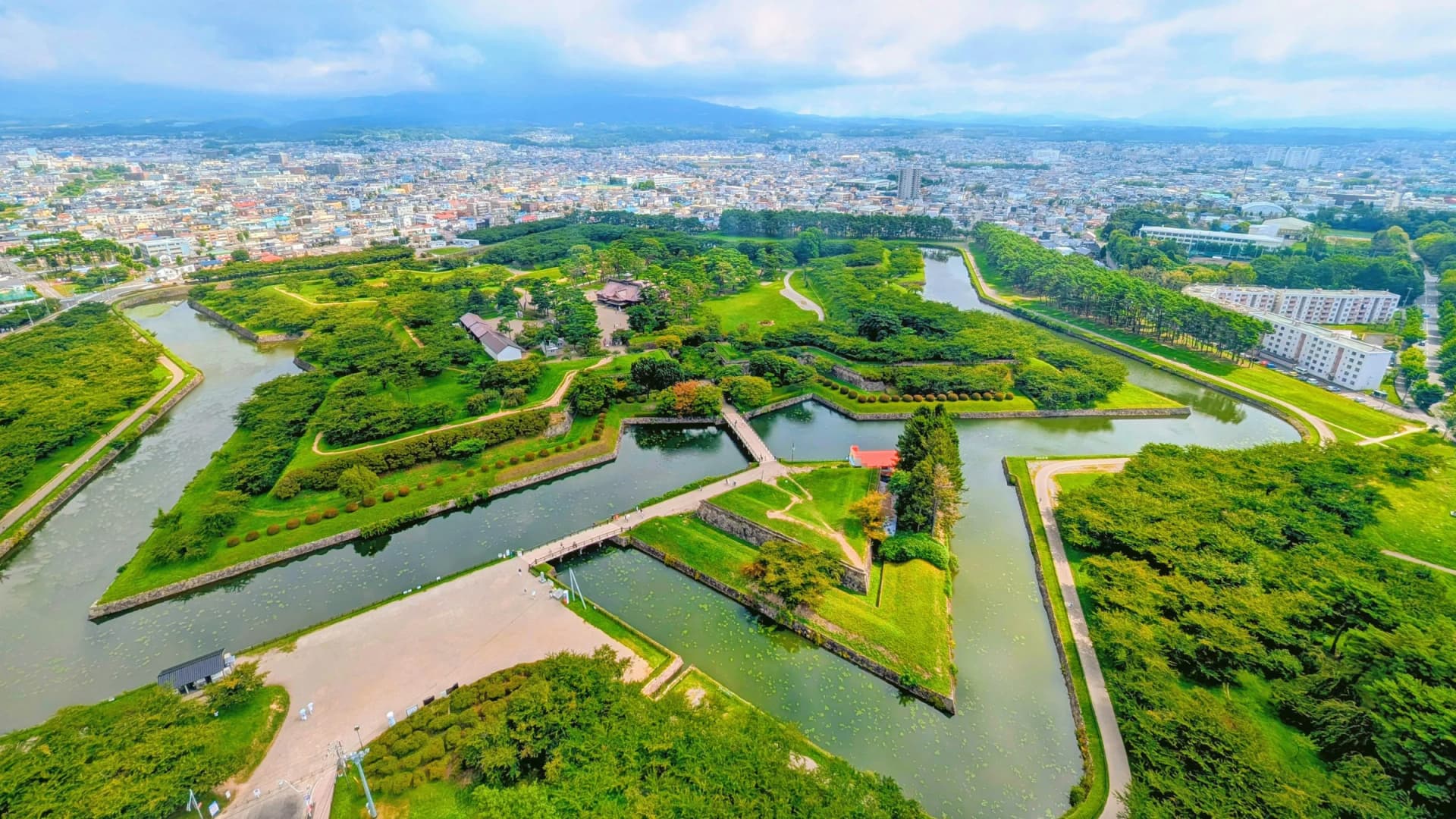
In the scenic port city of Hakodate on Hokkaido island lies one of Japan's most unique and historically significant fortresses. Goryokaku (lit. "five-point fort") is a star fort in the Japanese city of Hakodate on the island of Hokkaido, representing a fascinating fusion of Japanese history and Western military architecture.
A Revolutionary Design
The fortress was completed in 1866, two years before the collapse of the Tokugawa shogunate. It is shaped like a five-pointed star, making it Japan's first Western-style fortress. This allowed for greater numbers of gun emplacements on its walls than a traditional Japanese fortress, and reduced the number of blind spots where a cannon could not fire.
Goryokaku was designed in 1855 by Takeda Ayasaburo, a Rangaku scholar. He studied the fortified cities of Europe in the early modern period to design a fort that could protect against battles using guns and cannons. The construction was an ambitious project that took nearly seven years for the construction.
Historical Significance
The fortress played a pivotal role in Japanese history. The fortress was the site of the final battle between the Tokugawa soldiers and the pro-Imperial troops in the Boshin War of 1869. The defeat of the Tokugawa shogunate in this battle marked the start of the Meiji government.
It became the capital of the Republic of Ezo, a state that existed only in 1869. The fighting lasted for a week (June 20–27, 1869). This final confrontation marked the end of Japan's feudal era and the samurai age.
Cherry Blossom Wonderland
Goryokaku has become renowned as one of Japan's premier cherry blossom viewing destinations. There are nearly 1,500 cherry blossom trees, mainly of the Somei Yoshino species, on the premises of Goryokaku. The sight of the star-shaped fortress surrounded by pink sakura blossoms creates a breathtaking spectacle that attracts visitors from around the world.
The Magistrate's Office
In the center of Goryokaku stands a restored Hakodate Magistrate's Office, which was built here at the end of the Edo period. You can tour the interior and learn more about its history. This faithful reconstruction provides insights into the administrative functions of the fortress during its operational period.
A Living Monument
Today, Goryokaku is a park declared as a Special Historical Site, being a part of the Hakodate city museum and a citizens' favourite spot for cherry-blossom viewing in spring. The fortress serves as a bridge between Japan's feudal past and modern era, offering visitors a chance to walk through history while enjoying one of nature's most beautiful displays.
You might also like

Nagoya Castle
Castle constructed in 1612 as the center of a major Edo-era post station, destroyed in World War II bombing but reconstructed since 1957.
Nagoya · Aichi
Himeji Castle
Iconic castle with brilliant white exterior, designated UNESCO World Heritage Site and National Treasure, fully restored to its original appearance in 2015.
Himeji · Hyogo
Matsumae Castle
Japan's northernmost and final traditional Japanese castle, constructed 1850-1854 in Hokkaido as a strategic defense against foreign pressure during the late Tokugawa period.
Matsumae · Hokkaido
Jidai Festival
Kyoto's signature historical reenactment features costumed processions of figures from different Japanese eras traveling from the Imperial Palace to the Heian Shrine.
22 Oct 2026Kyoto
Himeji Castle Festival
Three-day festival featuring outdoor Noh theatre performances, classical arts, historical pageantry, and family activities across Himeji Castle grounds.
22–24 May 2027Himeji · Hyogo
Benkei Matsuri
Tanabe in Wakayama holds a two-day festival for Benkei, the warrior monk it claims as its own, with a play at the shrine and 600 dancers in wooden clogs.
2–3 Oct 2026Tanabe · Wakayama